Main programme · Future objective
Five product rails. One evidence-aware foundation model.
Zentari’s main scientific goal is to build a reusable multimodal model from the governed records produced by Scaffold Intelligence, Nano, Quantum Energy, Quantum Materials and Cell.
What foundation means here
A reusable scientific representation—not a replacement for solvers or laboratories.
The programme is not a chatbot wrapper or a claim that one network can replace domain physics. It is a governed model system that must retrieve evidence, use native tools when fidelity matters and refuse work outside its admitted domain.
Target architecture
Five scientific environments. One governed learning system.
Each product remains useful on its own while contributing typed representations, specialist tools and evidence-bound evaluations to a shared model programme.
- 01Scaffold
Geometry · flow · mechanics
- 02Nano
Carriers · fields · dynamics
- 03Energy
Workloads · forecasts · decisions
- 04Materials
Candidates · assays · selection
- 05Cell
State · environment · lifecycle
Identity · provenance · units · geometry · fields · uncertainty · applicability · authority
A multimodal, tool-using scientific model system designed to learn across governed records, call specialist engines and keep every proposal attached to its evidence and limits.
- RepresentGeometry, fields, traces, assays and programmes
- RetrieveSource-bound evidence and applicable prior cases
- OrchestrateSurrogates, optimisers, solvers and compute
- Decide carefullyCalibrated proposals, uncertainty and abstention
Evidence available today
The learning substrate starts with records that can be challenged.
These figures are current product evidence—not foundation-model training or performance results.
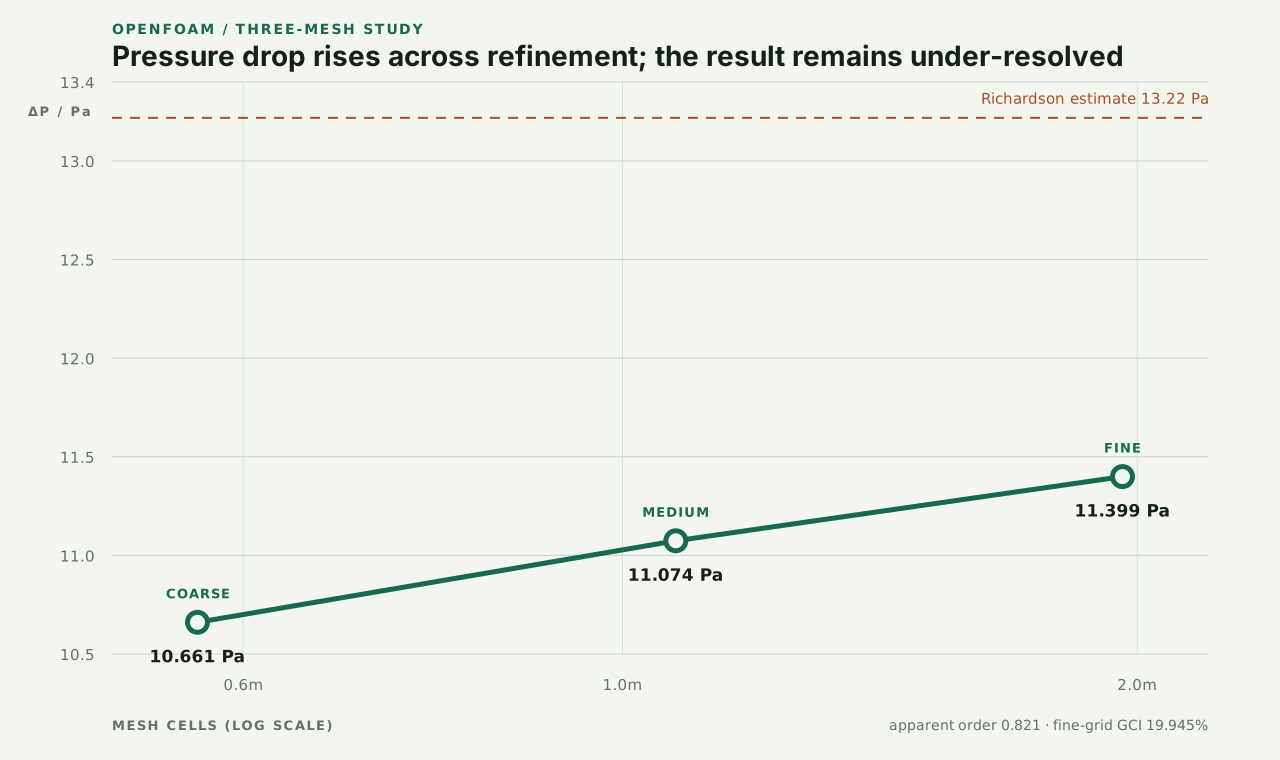
564,291 → 1,960,469 cells · ΔP 10.661 → 11.399 Pa
Fine-grid GCI 19.945%; under-resolved, standalone and not a measurement.Open evidence →
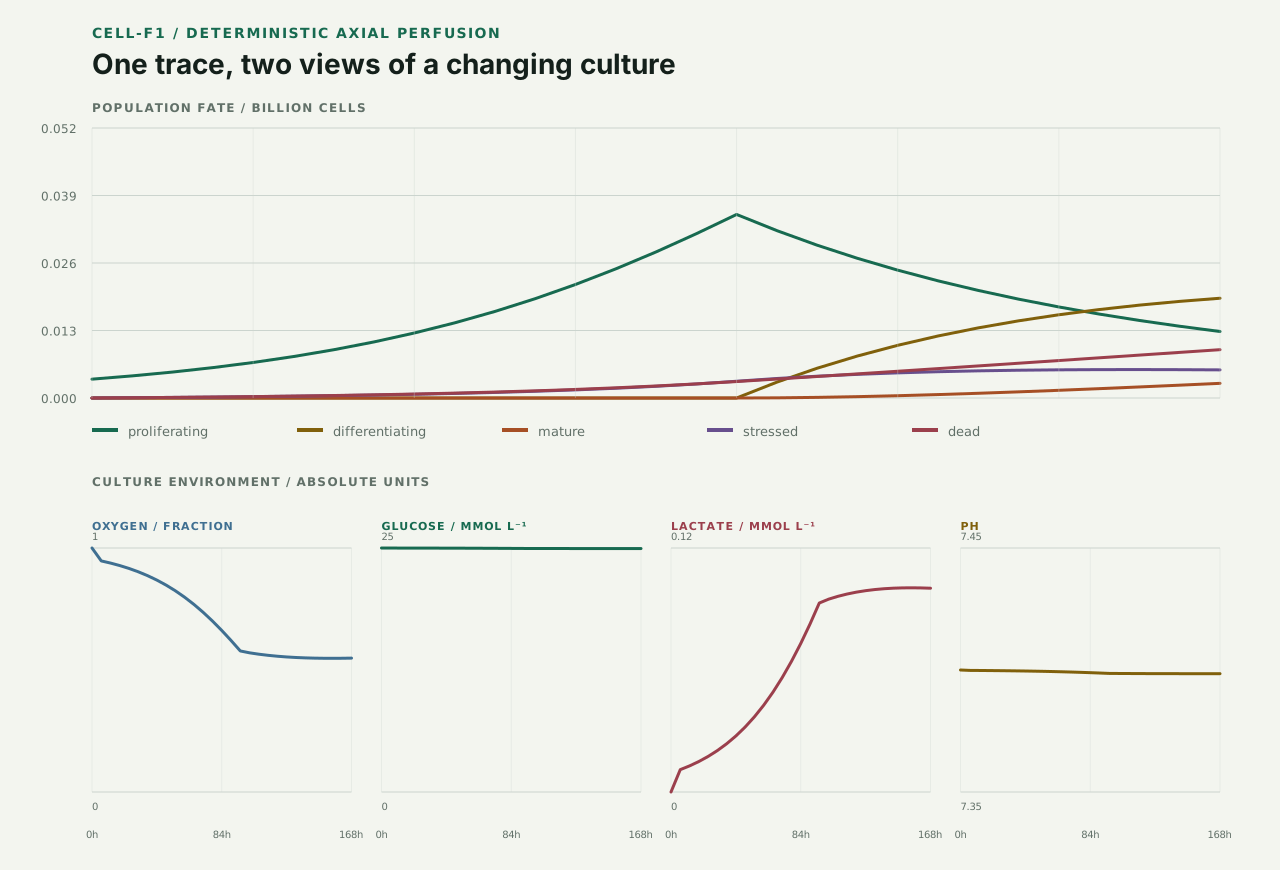
celltrace-7d87ae1e… · 174 snapshots · 0–168 h
Reduced-order, literature-order structural priors; no biological or laboratory validation.Open evidence →
Five governed inputs
Every product contributes a different observation space.
Shared representation must preserve each domain’s units, identity, uncertainty and authority rather than flattening them into unqualified tokens.
Scaffold Intelligence
Geometry, OpenFOAM flow and transport fields, FEniCSx mechanics, design identity and numerical uncertainty.
Current public CFD is under-resolved and no scaffold outcome is laboratory validated.
Zentari Nano
Carrier identity, analytic and stochastic dynamics, optimisation histories and future rig trajectories.
Current public evidence is analytic or internal in-silico; there are no hardware labels.
Quantum Energy
Workload constraints, forecast context, execution cost, decisions and bounded telemetry for deciding where and when to spend compute.
This is the resource-control rail, not scientific ground truth; current evidence is counterfactual replay.
Quantum Materials
Typed candidates, molecular or material descriptors, assays, selections and active-learning records.
The current public loop is emulated and contains no measured material result.
Zentari Cell
Lifecycle programme identity, population and environment traces, and future observation operators linking simulation to microscopy, omics and assays.
Cell-F1 is an uncalibrated reduced-order prior; the protein programme is context-only today.
Honest state split
An evidence spine exists. The foundation model does not—yet.
No current figure, trace or benchmark is foundation-model performance evidence.
Governed product rails
Deterministic engines, source-pinned records, evidence classes, native-solver handoffs, abstention controls and bounded telemetry.
Cross-domain model evidence
A permissioned training corpus, trained multimodal system, demonstrated transfer, calibrated out-of-distribution behaviour and prospective external validation.
Intended model behaviour
A six-stage scientific reasoning loop.
Tool use and abstention are part of the model contract, not fallback copy added after prediction.
- 01Retrieve
Find source-linked records within the admitted scope.
- 02Represent
Align modalities without erasing units or identity.
- 03Propose
Generate candidates, experiments or compute plans.
- 04Quantify
Report uncertainty, applicability and alternatives.
- 05Route
Escalate decisive cases to native solvers or laboratories.
- 06Update
Retrain only through reviewed, versioned evidence.
Admission programme
The model earns authority task by task.
Scale, fluency or one benchmark cannot grant scientific authority across the suite.
Corpus integrity
Verify rights, provenance, units, coordinate frames, duplicates, evidence class and withdrawal state before training.
Leakage-safe evaluation
Hold out grouped candidates, time periods, sites and complete domains so memorisation cannot masquerade as transfer.
Strong baselines
Compare with each product’s analytical, statistical, surrogate and solver-backed methods under equal evidence and compute budgets.
Scientific reliability
Measure calibration, domain shift, out-of-distribution abstention, invariants or conservation where applicable, and inference cost.
Prospective challenge
Predeclare tests on unseen solver cases and independently retained laboratory or operational observations.
Governed release
Retain immutable model and data receipts, evaluation reports, telemetry caps, rollback and no silent online learning.